Request Quote
Scan the QR code below to connect with us on WhatsApp.

Request Quote
Scan the QR code below to connect with us on WhatsApp.
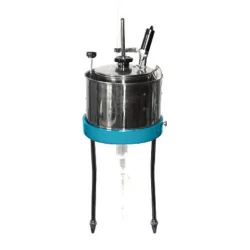
Lab Expo Engler Viscometer 52-EVM100 features a graduated flask with a capacity of 200 ml, ensuring precise measurements for accurate viscosity testing. It offers a temperature range of 0 to 100°C, providing controlled conditions. It features a standard water value of 51 seconds, ensuring reliable calibration. It is designed as per ASTM D1665 standards, ensuring precise testing & performance.
$3,739.00 $ 3116
| Graduated Flask | 200 ± 0.2 ml |
| Standard Water Value | 51 ± 1 s |
| Temperature Range | 0 to 100 °C |
| Temperature Controlling Accuracy | ± 0.2 °C |
| Accuracy Of Timer | 0.01 s |
| Dimension | 510 x 360 x 270 mm |
| Power Of Heater | 550 W / 220 V |
Function Implementation Viscosity testing labs 51 ± 1 s standard water value ensures reliable calibration Quality control facilities ±0.2°C temperature controlling accuracy supports precise measurements Research laboratories 0 to 100°C temperature range enables controlled testing conditions Clinical analysis units 200 ± 0.2 ml graduated flask provides accurate sample volume Industrial process monitoring Timer accuracy of 0.01 s allows exact flow time measurement
Lab Expo Engler Viscometer units are used for determination of viscosity of petroleum products and bituminous materials under controlled thermal conditions. The range includes 100 ml and 200 ml graduated flask configurations, with standard water flow time of 51 ± 1 s and operating temperatures from 0 to 100 °C. Select models support dual-volume measurement for bituminous samples, enabling comparative flow behavior analysis in fuel testing, asphalt evaluation, and viscosity-based quality control workflows.


