Request Quote
Scan the QR code below to connect with us on WhatsApp.

Request Quote
Scan the QR code below to connect with us on WhatsApp.
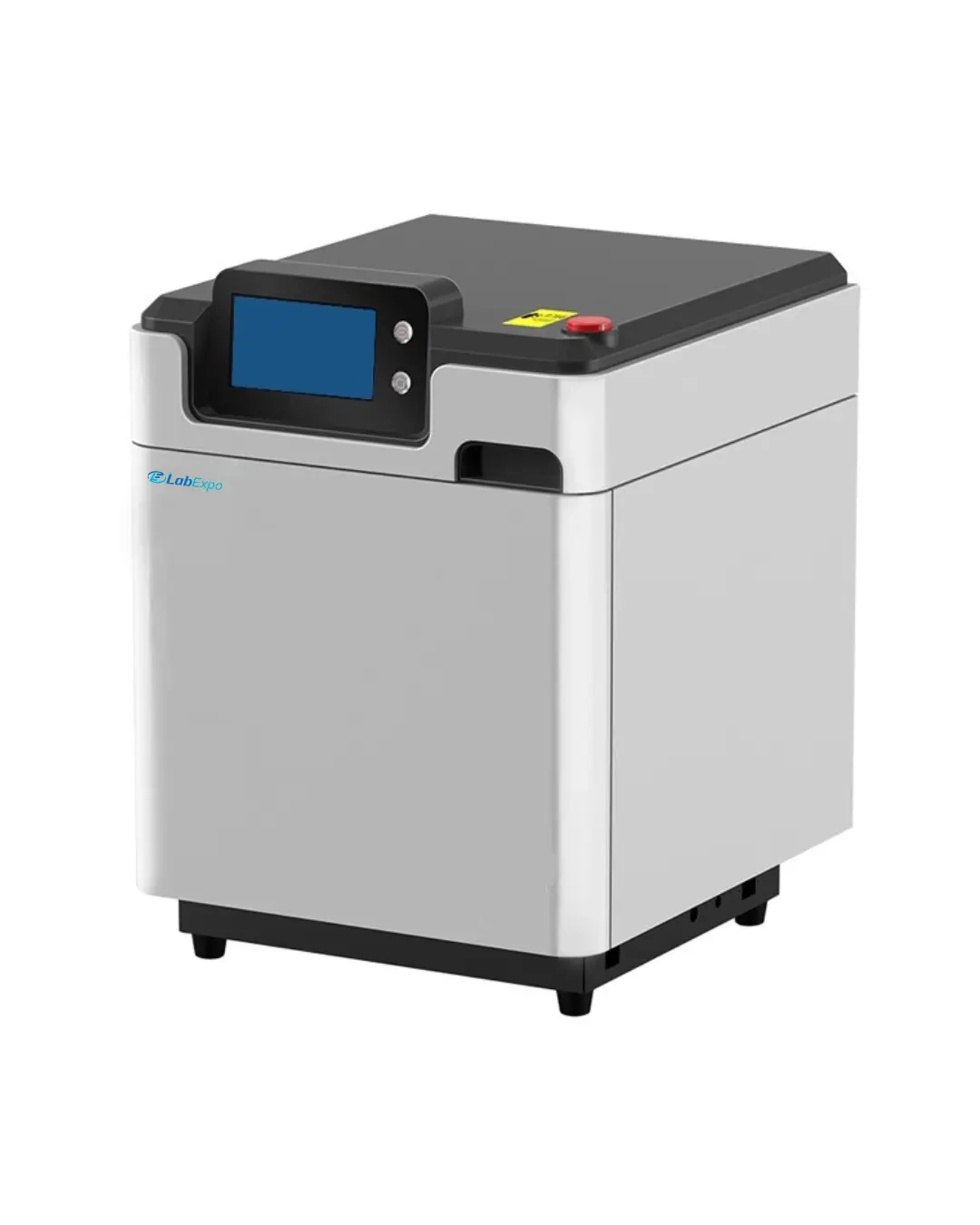
Lab Expo Microwave Digestion System LE-MDS101 supports a maximum working pressure of up to 6 MPa to ensure robust operation. Equipped with 8 high-performance vessels, allowing simultaneous sample processing. Features a contactless pressure sensor for accurate and safe pressure measurement. Built with color touch screen for intuitive and user-friendly control. Our Microwave Digestion System delivers reliable and efficient sample digestion for modern laboratory needs.
$14,292.00 $ 11910
| Vessel Quantity | 8 |
| Pressure Monitoring | Contactless Pressure Sensor |
| Max. Working Pressure Range | 6 MPa |
| Temperature Monitoring | Contactless IR Sensor |
| Max. Working Temperature | 250℃ |
| Temperature Accuracy | ±0.1℃ |
| Vessel Volume | 100 mL |
| Display | 7 inches Color Touch Screen |
| Rotation | 360° Continuous Rotation |
| Microwave Power | 0 to 1000W (Adjustable) |
| Microwave Frequency | 2450 MHz |
| Cavity Volume | 35 L |
| Microwave Leakage | |
| Power | AC 220V±10%, 10A, 50/60Hz |
| Dimension | 490 × 560 × 630 mm |
| Weight | 47 kg |
Function Implementation Sample batch processing 8 vessels enables simultaneous sample digestion High-pressure applications 6 MPa max working pressure ensures safe operation Temperature-controlled digestion ±0.1℃ accuracy supports precise thermal control Continuous sample rotation 360° rotation promotes uniform heating distribution User-friendly operation 7-inch touch screen simplifies parameter setup
Sample Pretreatment/Acid-removing Heating Equipment (Heating Blocks), set of 12
1: How many vessels does the LE-MDS101 model support?
The LE-MDS101 supports up to 8 high-performance digestion vessels, allowing efficient batch sample processing.
2: What is the maximum working pressure of the system?
The system supports a maximum working pressure of 6 MPa, ensuring robust and reliable operation.
3: How is temperature and pressure monitored during digestion?
The system uses contactless infrared sensors for temperature and contactless pressure sensors for real-time pressure monitoring, ensuring safe and accurate readings.
4: Does the system feature any safety mechanisms?
Yes, it includes an explosion-proof cavity, electromagnetic protection design, and high-power turbulent air cooling to ensure safe operation.
5: Can the system be used for different types of sample analysis?
Absolutely. It is ideal for environmental testing, food safety analysis, pharmaceutical research, and materials science applications.
6: What is a Microwave Digestion System?
A microwave digestion system is a laboratory instrument that uses microwave energy to rapidly heat and break down sample materials in sealed vessels for subsequent elemental analysis.
7: How does the auto-vent and self-resealing mechanism work?
This feature allows vessels to automatically release excess pressure in case of overpressure and then instantly reseal, minimizing the risk of accidents and preserving sample integrity.
8: What is the advantage of contactless monitoring?
Contactless sensors reduce the risk of sample contamination and wear, while improving measurement precision and safety during digestion.
9: Are different models available under this category?
Yes, Lab Expo offers a range of microwave digestion systems with varying vessel capacities, power outputs, and automation features tailored to diverse laboratory needs.
10: What applications is this system suitable for?
It is ideal for sample digestion in applications such as TOC analysis, TIC/TC/TOC measurement, chemical digestion, inorganic and organic compound digestion, and elemental testing across various scientific disciplines.
Lab Expo Microwave Digestion Systems are structured around sealed-vessel microwave heating to enable controlled acid digestion under elevated temperature and pressure. This microwave digester supports high-throughput batch processing with real-time pressure and temperature monitoring. Automated venting with self-resealing vessels, contamination-controlled chamber design, and stable energy delivery ensure repeatable sample decomposition for analytical, environmental, food, and research laboratory workflows.


