



Sunlight slowly yellows plastics, fades pigments and cracks coatings, but waiting years for outdoor results delays product decisions. A controlled UV chamber shortens that wait and makes comparisons repeatable. This guide explains how the exposure works, which lamp to choose, how to plan a test and read the results, and where selection goes wrong.
Why Accelerated UV Exposure Matters
A uv aging test chamber compresses the outdoor factors that most often break down polymers, coatings and automotive trim: ultraviolet radiation, elevated temperature and moisture. Natural exposure is slow, varies by season and site, and is hard to repeat. A chamber holds the conditions steady, so two formulations can be compared fairly.
That is the working idea behind a uv weathering test chamber: it ranks materials and flags weak formulations early. It does not predict an exact service life, because no lab cycle reproduces all outdoor variables.
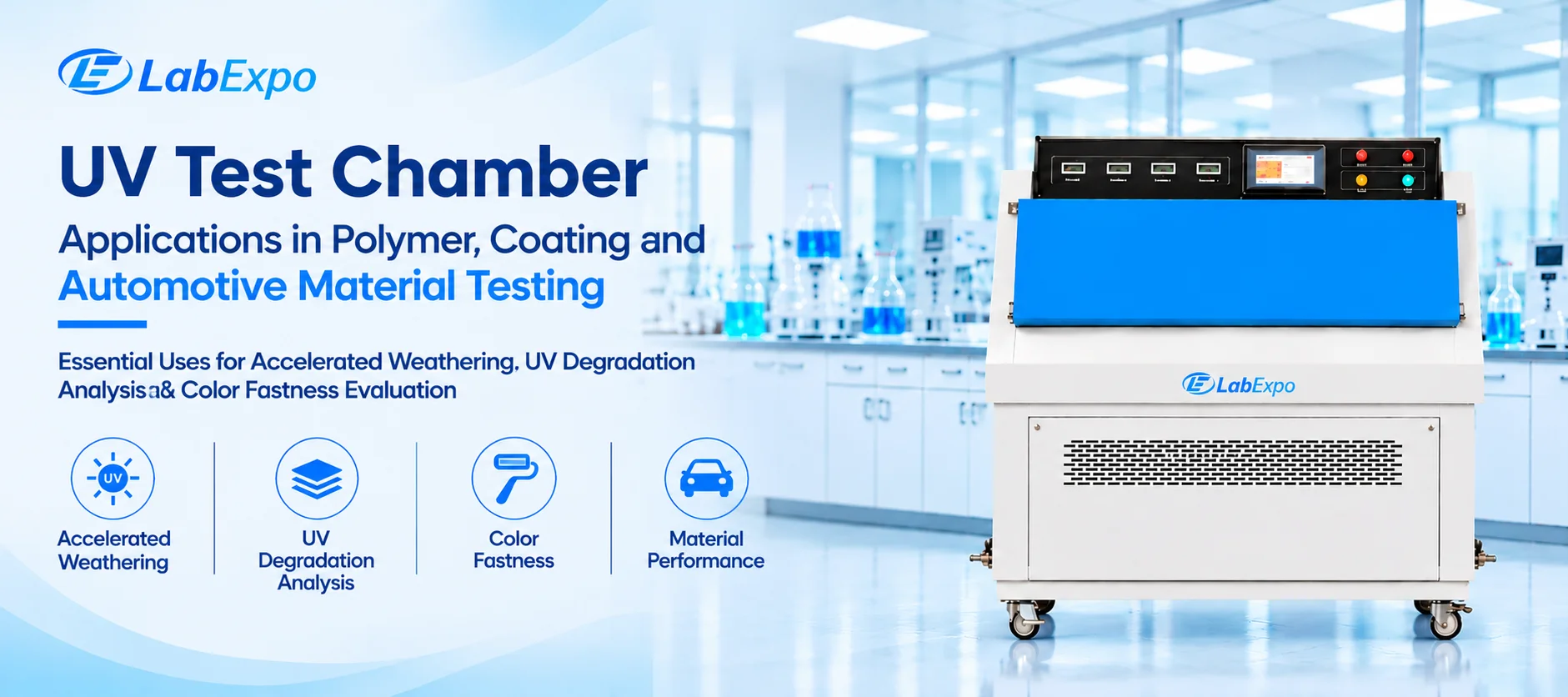
The UV Test Chamber 24-UTC100 listing describes selectable UV-A, UV-B and UV-C lamps, adjustable light intensity, a 50 °C to 75 °C UV temperature range and a touchscreen interface.
How Light, Heat and Moisture Act on a Sample
Photons in the ultraviolet band carry enough energy to break chemical bonds in polymer chains and pigments. Heat speeds the reactions that follow, and moisture adds hydrolysis and washes away degraded surface material. The sequence below shows how a chamber applies these factors in order.
- 1
Load specimens
Flat panels are mounted in holders. The listing gives a capacity of 48 or 50 pieces at 75 x 150 mm, and it states both numbers.
- 2
Choose the lamp
The lamp type sets the wavelength band that reaches the samples, and with it how closely the test resembles sunlight.
- 3
Set intensity
Light intensity is adjustable, so the exposure level can match the method or the material being studied.
- 4
Hold temperature
The chamber maintains a UV temperature between 50 °C and 75 °C during the light phase.
- 5
Add moisture
The listing states 8 liters of distilled water per day, tied to humidity stability. Condensation phases mimic dew and rain.
- 6
Inspect and compare
Samples are removed at set intervals and compared against unexposed control pieces.
A uv light test chamber differs from a heat-only oven because the radiation itself is the stressor. A uv radiation test chamber also differs from a germicidal cabinet, where UV is used to disinfect surfaces rather than to age materials. A uv accelerated aging chamber is judged on how steady its light output and temperature stay over hundreds of hours, since drift quietly changes the dose each sample receives.
Where the Testing Fits: Polymers, Coatings and Automotive Parts
The product page links the chamber to UV aging tests, batch validation, quality control and material durability checks. In practice, four groups of materials use this kind of exposure most often.
Polymers and plastics
Yellowing, surface crazing and loss of flexibility show how well a stabilizer package is working.
Coatings and paints
Gloss loss, chalking and film cracking are compared across formulations on matching panels.
Automotive materials
Dashboard skins, trim, seals and exterior parts are checked for color shift and surface change.
Color fastness
Dyes, pigments and printed surfaces are exposed, then rated against an unexposed reference.
Hospital and research laboratories use the same approach on plastic housings, tubing and packaging polymers that sit near windows or under strong lighting. In many labs the unit is simply called a uv weathering tester, whatever the material under study.
Lamp Types: UV-A, UV-B and UV-C
Lamp choice is the largest single decision in a test plan. The table sets out what the listing says about each type, followed by a practical note.
| Lamp | Listing description | Practical note |
|---|---|---|
| UV-A | Simulates sunlight, 365 nm to 295 nm cut-off | Closest to the UV part of sunlight and a common choice for general weathering comparisons |
| UV-B | Simulates short-wavelength UV reaching Earth's surface | Faster and more aggressive, though it can cause damage that rarely appears outdoors |
| UV-C | Described as simulating UV sunlight through windows | Confirm the lamp designation, since window-filtered sunlight is normally reproduced with a different lamp type and UV-C does not reach the ground |
The UV-C wording and the 365 nm to 295 nm cut-off phrasing on the page are unusual. Ask the supplier for the exact lamp model and its spectral output before writing a test method around them.
Reading the Results: What Degradation Looks Like
A good test records change in numbers as well as in photographs. Each property below needs an unexposed control for comparison.
| Property | How it is usually checked | Point of caution |
|---|---|---|
| Color change | Colorimeter reading, reported as a color difference value | Measure the same spot and use the same geometry each time |
| Gloss | Gloss meter at a set angle | Dirt and condensation marks distort the reading |
| Chalking and cracking | Visual rating against a reference scale, sometimes under magnification | Ratings need a trained and consistent reviewer |
| Yellowing | Yellowness index from a spectrophotometer | Thickness and substrate color change the reading |
| Strength and elongation | Tensile testing on exposed and control pieces | Needs extra specimens set aside from the start |
A result is only meaningful when the comparison is fair: same sample size, same position in the chamber and same exposure hours. Racks should be repositioned at intervals, because light and temperature are rarely identical across all positions.
Using the Chamber in a Laboratory: Setup and Routine
A common search is "can uv test chamber used in laboratory" work for routine material screening. The answer is yes, provided the lab can supply the power, distilled water and ventilation, and can manage UV safety. Searches such as "what uv test chamber how to use" usually want a short procedure, which follows.
Running a uv test chamber in lab space starts with the site: a level floor for a 136 kg unit, clearance around the cabinet, and the supply listed on the product page. A basic uv test chamber how to use outline looks like this:
- Cut and label specimens to the listed 75 x 150 mm size, and keep control pieces in the dark.
- Record starting color, gloss and mass or mechanical values before loading.
- Mount specimens firmly in the holders, with the test surface facing the lamps and no gaps in the rack.
- Select the lamp type, light intensity and temperature on the touchscreen according to the written method.
- Fill the water supply with distilled water only, since mineral deposits spoil both samples and sensors.
- Start the cycle, and log elapsed hours, lamp hours and any alarms.
- Pause at planned intervals to inspect, measure and move specimens to a new position.
Anyone learning how to use uv chamber controls should treat safety as part of the procedure. UV lamps can injure eyes and skin, so doors and interlocks must stay working, and lamps should never be viewed directly. Routine uv test chamber use also includes tracking lamp ageing, because output falls with hours and old lamps change the dose.
Planning an Exposure Program: A Worked Example
The figures below are illustrative. They combine the listed capacity and water use with a common alternating pattern of 8 hours of UV light followed by 4 hours of condensation. Your method may set different times and temperatures.
| Item | Assumption or calculation | Result |
|---|---|---|
| Target exposure | 1,000 hours of cycling | 1,000 h |
| Cycle length | 8 h UV plus 4 h condensation | 12 h, about 83 cycles |
| Duration in days | 1,000 h ÷ 24 h | about 42 days |
| Specimen plan | 48 positions ÷ 6 formulations | 8 pieces each: 3 for color and gloss, 3 for mechanical tests, 2 spare |
| Distilled water | 8 L per day × 42 days, at the stated daily rate | up to about 336 L |
The water line is an upper bound from the listing, since actual use depends on the cycle. The calculation still shows why a lab should plan a distilled water supply early. A 42-day run also occupies the chamber for six weeks, so queues of materials need scheduling rather than hope.
Specifications Worth Reading Closely
The values below come from the 24-UTC100 listing. The second table shows details the page leaves out and that a test method will usually need.
| Parameter | 24-UTC100 listing | Why it matters |
|---|---|---|
| UV temperature range | 50 °C to 75 °C | Sets which exposure methods fit |
| Capacity | 48 or 50 pieces, 75 x 150 mm | Limits how many formulations run in one batch |
| Lamps | UV-A, UV-B, UV-C, adjustable intensity | Controls how closely the test resembles sunlight |
| Control | Touchscreen for light and temperature | Shapes programming and monitoring |
| Water use | 8 L per day, distilled | Needs a clean water supply and drain plan |
| Dimensions | 137 x 53 x 136 cm | Determines bench or floor space and doorway access |
| Power | 1-phase, 120 V / 60 Hz / 16 A or 230 V / 50 Hz / 9 A, 1800 W maximum | Needs the correct supply and a dedicated circuit |
| Weight | 136 kg | Affects floor choice and handling |
| Not stated on the page | Why a method needs it |
|---|---|
| Irradiance level and how it is measured | Dose is irradiance multiplied by time |
| Humidity or condensation range | Moisture settings drive many failure modes |
| Lamp model, count and replacement interval | Spectral output defines the test |
| Test standards followed | Methods set cycle times, temperatures and reporting |
| Calibration approach | Traceable measurement supports comparable results |
Selection Mistakes to Avoid
- Choosing the strongest lamp for speed. Shorter wavelengths can create failure modes that never occur outdoors.
- Reading hours in the chamber as years outdoors. The ratio differs by material, climate and cycle.
- Ignoring the specimen layout. A uv test chamber for laboratory work should fit the sample size and the number of replicates the method needs.
- Skipping controls. Without unexposed pieces and a reference material, change cannot be separated from measurement drift.
- Overlooking utilities. Distilled water, power, ventilation and floor load are part of the purchase decision.
- Forgetting lamp upkeep. Output declines with hours, so replacement and monitoring belong in the plan.
- Assuming standard compliance. The page lists no test standards, so confirm that the chamber can meet the method you intend to follow.
Choosing Between Fluorescent UV, Xenon Arc and Outdoor Exposure
No single method answers all questions. The comparison below shows where each approach fits.
| Method | Light source | Strength | Limit |
|---|---|---|---|
| UV chamber (fluorescent lamps) | UV-A or UV-B lamps with heat and moisture | Fast screening of polymers and coatings on a modest utility load | Little visible or infrared light, so color effects driven by those bands are under-represented |
| Xenon test chamber | Filtered xenon arc lamp | Full-spectrum match to sunlight | More complex cooling and a larger service load |
| Outdoor exposure | Real sunlight and weather | Highest realism | Slow, and results vary between sites and years |
Many labs use a UV chamber to screen candidates, then confirm the finalists with xenon or outdoor racks. Other chamber types in the wider test chambers category serve different questions, such as ozone cracking or temperature and humidity stress.
Exploring the Wider Test Chamber Range
This chamber belongs to the environmental test group at Lab Expo, a group that covers drug stability, flammability, ozone, plant growth, salt spray, sand and dust, temperature and humidity chambers. The full range of test chambers shows each subcategory and its models.
Within the UV test chamber family, two more models are listed: the 24-UTC200, whose page lists 30 specimens per rack on a rotating rack, and the 24-UTC201. Neighboring chambers include the ozone test chamber and the strong illumination stability test chamber.
Whichever uv test chamber for lab work is being considered, buyers usually compare:
- light source type and spectral output
- temperature and humidity range
- specimen capacity and rack design
- controller and data logging
- power, water and floor requirements
- safety interlocks and service support