



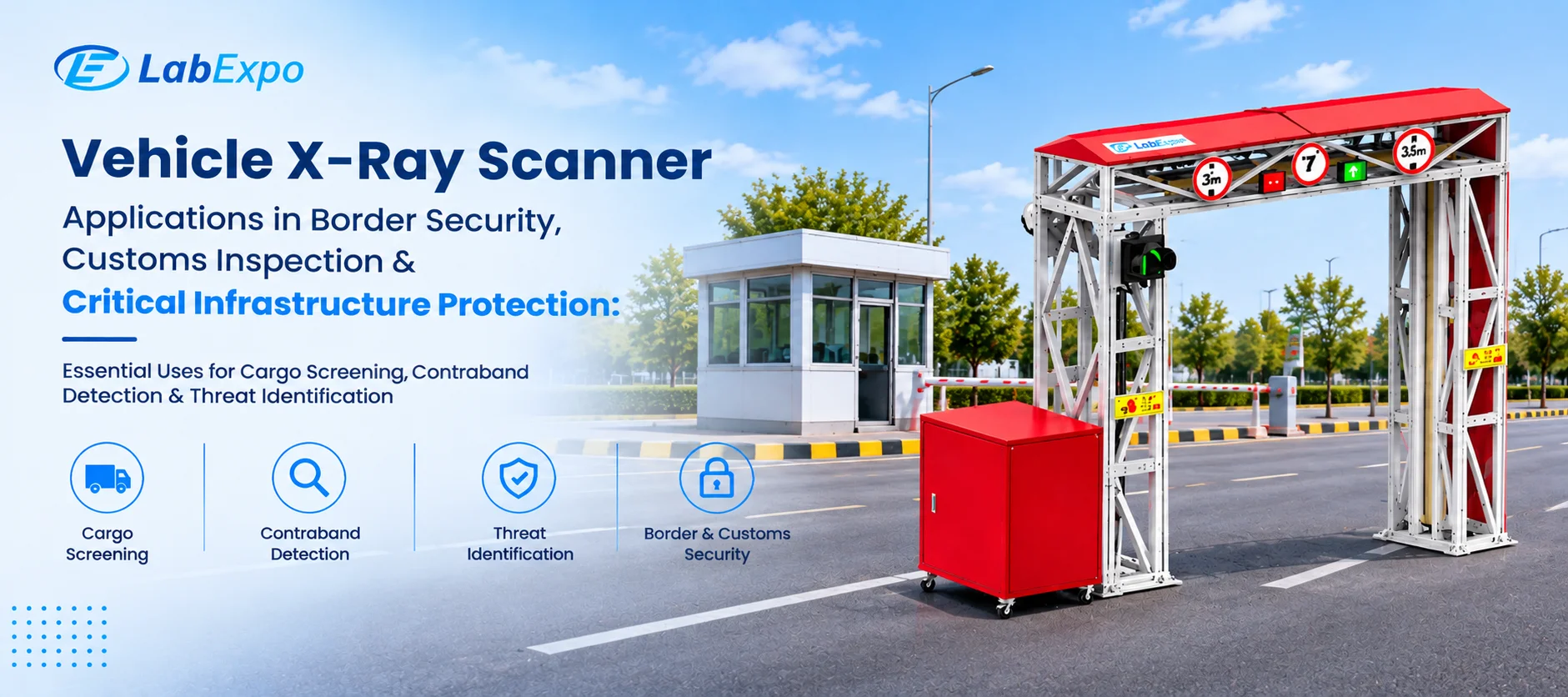
Opening all the cars at a checkpoint is slow, intrusive and hard to repeat consistently. Imaging a vehicle as it drives through is faster and leaves the inspection record on a screen rather than in an officer's memory. This guide covers how transmission imaging works, what the images can and cannot show, how throughput and dose figures should be read, and where selection and site planning go wrong.
What Vehicle Screening Aims to Achieve
This approach is called a non intrusive vehicle inspection system because it screens contents without a physical search. It does not replace officers, dogs or document checks. It adds a layer that is quick to apply and leaves a stored record, which helps where volumes are high and inspection rules must be applied consistently.
The Vehicle X-Ray Scanner LE-VXS102 is a drive-through unit with a listed pass rate of 100 cars per hour at 5 to 10 km/h, using dual-energy imaging from a 200 kV source.
How Dual-Energy Transmission Imaging Works
A vehicle x ray inspection system follows the sequence below. The notes also point out the features the LE-VXS102 listing names.
- 1
Approach
The vehicle enters the lane and passes through the channel, listed at 3000 x 3000 mm, at a steady 5 to 10 km/h.
- 2
Trigger
Sensors detect the vehicle and start the scan as it enters the beam plane.
- 3
Emit
A 200 kV sealed oil-cooled source produces a thin fan beam. The listing describes top-illuminated imaging.
- 4
Detect
A line of detectors records the X-rays that pass through, at two energy levels in a dual-energy system.
- 5
Build the image
Software assembles the lines into a picture and colors it by how materials absorb at each energy.
- 6
Review
An operator examines the image on a 24-inch console, using zoom, color and playback functions.
A drive through x ray scanner builds the picture line by line as the vehicle moves, so steady speed matters: a vehicle that speeds up, slows down or stops distorts the image. The listing also names a vehicle bottom detection system, which supports inspection of the underside, though the page gives no detail on how it works.
Practical Use Cases at Checkpoints and Facilities
A vehicle security scanner is used wherever many vehicles must be screened quickly at a fixed point. The product page lists border checkpoints, port facility inspections, drive-through security lanes, customs control points and sensitive facility access, and the cards below describe how each setting uses it.
Border checkpoints
Passenger and light vehicles are imaged on approach, with the stored image supporting a secondary search if something looks unusual.
Ports and customs points
Dual-energy imaging separates organic from inorganic material, which helps an operator decide which vehicles to refer for inspection.
Sensitive facility access
Entry lanes at critical sites image arriving vehicles and keep a record of each pass for later review.
Drive-through security lanes
Continuous scanning at 5 to 10 km/h means a vehicle screening system can operate without a full stop at the portal.
The title of this guide mentions cargo screening, but the LE-VXS102 listing speaks of cars, with a 3000 x 3000 mm channel. Freight-scale inspection uses a different class of equipment, covered in the comparison below.
Reading the Image: What It Shows and Where It Stops
An X-ray image is evidence for an operator, not a verdict. The table below sets each image feature next to a limit that matters when images are reviewed.
| Image feature | What it shows | Limit to keep in mind |
|---|---|---|
| Material coloring | Organic material is commonly shown in orange tones and inorganic in blue, with mixed material between | Color indicates absorption, not identity, so many harmless items look alike |
| Penetration | How thick a steel section can be imaged | Dense areas such as engine blocks may stay dark |
| Fine detail | The listing gives a 1.2 mm copper wire value | Detail drops for small items in cluttered areas |
| Underside view | A bottom detection system is listed | The page does not explain the method |
| Image tools | Zoom, color, reverse color, organic or inorganic removal, playback | Results depend on operator training and consistent review rules |
False alarms are a normal feature of image-based screening, because many legitimate loads are dense or organic. Referral procedures, such as a secondary search or a second review of the stored image, are part of using the scanner as intended.
Throughput and Lane Planning: A Worked Example
A pass rate of 100 cars per hour sounds like a scanner figure, yet the scan itself takes only seconds. The arithmetic below is illustrative, using the listed speed range and an assumed 5 m vehicle.
| Quantity | At 10 km/h | At 5 km/h |
|---|---|---|
| Speed in meters per second | 2.78 m/s | 1.39 m/s |
| Time for a 5 m vehicle to cross the beam | about 1.8 s | about 3.6 s |
| Time per vehicle at 100 cars/h | 36 s | 36 s |
| Spacing between vehicle fronts at 10 km/h and that rate | about 100 m | about 50 m at 5 km/h |
The result shows that scan speed is rarely the limit. Queue handling, document checks, driver instruction and referral decisions fill most of the 36 seconds. Lane length for staging vehicles to a steady approach speed, and a safe area for referred vehicles, matter as much as the scanner. The listing says the rate is up to 100 cars per hour but gives no test conditions.
Radiation Safety and Dose Figures
Any vehicle x ray machine raises questions about dose, and the answers depend on figures that should be read carefully. The listing gives the values below.
| Parameter | LE-VXS102 listing | What it means |
|---|---|---|
| Absorbed dose, single scan | Below 0.2 µSv | The dose from one pass; natural background is typically several microsieverts per day |
| Boundary dose, common area | Below 0.5 µSv, stated as in accordance with IAEA standards | The dose at the edge of the controlled zone |
The listing also states that drivers need not leave the vehicle. Whether occupants may remain inside during a scan is a regulatory and policy decision that varies by country, so it should be checked with the radiation protection authority before deployment. Standard practice also includes a marked controlled zone, warning signs, interlocks, operator training and dose monitoring under the ALARA principle. The compliance wording on the page should be confirmed with supporting documents, and approvals for a given site should be confirmed with the supplier and local authority.
Passenger-Vehicle and Freight-Scale Systems Compared
Scale decides the channel size, the source energy and the site works. The comparison below describes typical characteristics rather than any one model.
| System | Typical channel | Typical fit | Consideration |
|---|---|---|---|
| Passenger-vehicle drive-through | About 3 m wide and high | Cars and light vans at checkpoints | Quick lane operation, limited to vehicle height and weight |
| Truck x ray scanner or cargo vehicle scanner | Taller portal, often with higher-energy sources | Freight trucks and containers at ports and borders | Larger site works, shielding and exclusion zones |
| Under-vehicle surveillance | Camera or mirror at the lane | Underside inspection without X-rays | Shows visible items only, not contents |
Vehicle x-ray scanners sit alongside under-vehicle systems and baggage scanners in the wider security systems category, and the vehicle types to be screened usually decide the class before other specifications are compared.
Operator Workflow and Training
A short vehicle x-ray scanner how to use outline follows. The operating manual and the site procedure take priority.
- Brief drivers on approach speed and spacing, since steady speed produces a clean image.
- Keep people clear of the controlled zone and confirm that warning indicators are active before each scan.
- Log in with the operator password and review each image with the zoom, color and material tools.
- Follow written referral rules for flagged vehicles rather than individual judgment alone.
- Use the stored image, playback and data query functions to support secondary checks and audits.
- Manage user accounts so that only trained operators change settings.
- Schedule routine checks of image quality and dose with a qualified service provider.
Specifications Worth Reading Closely
A vehicle x-ray scanner device datasheet combines imaging, safety and site figures. The values below come from the LE-VXS102 listing, which is also summarized in its product catalog.
| Parameter | LE-VXS102 listing | Why it matters |
|---|---|---|
| Source and detection | 200 kV sealed oil cooled, dual energy | Sets penetration and material discrimination |
| Penetration | 45 mm steel typical, 25 mm application value | The gap between the two values should be explained by the supplier |
| Fine detail | 1.2 mm diameter copper wire | Indicates the smallest wire the system can show |
| Speed and pass rate | 5 to 10 km/h, 100 cars/h | Sets lane design and queue planning |
| Channel | 3000 x 3000 mm | Limits the vehicles that can pass through |
| Console and software | 24-inch console, password login, image tools, data query, playback, live video | Shapes daily operation and record keeping |
| Dose | Single scan below 0.2 µSv, boundary below 0.5 µSv | Needed for the radiation protection assessment |
| Environment | 5 to 40 °C operating, 0 to 90 % humidity | Outdoor lanes may need weather protection |
| Power | AC 220 V ±10 %, 50 Hz, 2 KVA | Needs a matching supply |
| Shipping and weight | Three assemblies, 11.373 m³ in total, 750 kg net, 1000 kg gross | Affects transport, lifting and foundation planning |
The listing does not state foundation requirements, exclusion zone dimensions, maximum vehicle weight or the data storage capacity. Those details are worth requesting before site design begins.
Selection Mistakes to Avoid
- Choosing by pass rate alone. Lane layout and procedure usually limit throughput before the scanner does.
- Assuming that a car-scale channel covers trucks. Freight vehicles need a larger portal and a different class of system.
- Skipping the dose review. Occupant scanning rules and the controlled zone should be checked with the regulator early.
- Reading penetration as a promise of seeing through dense areas.
- Ignoring operator training. Image reading depends on skill and on written referral rules.
- Overlooking site works, including foundations, power, weather protection and data connections.
- Comparing suppliers on specifications alone. Documentation, training, service and spare parts affect long-term use.
Exploring the Wider Vehicle Screening Range
This scanner belongs to the vehicle X-ray group at Lab Expo, within a security portfolio that also includes X-ray baggage scanners. According to the vehicle x-ray scanner range page, the group is designed for border control, industrial and checkpoint screening, with speeds of 5 to 10 km/h and pass rates up to 100 cars per hour, and the Vehicle X-Ray Scanner LE-VXS101 is listed with 70 mm steel penetration.
Within this category, options are usually weighed on source energy and penetration, channel size, throughput, dose figures, software and storage, power supply and site works. The complete Security Systems category lists the configurations available.