



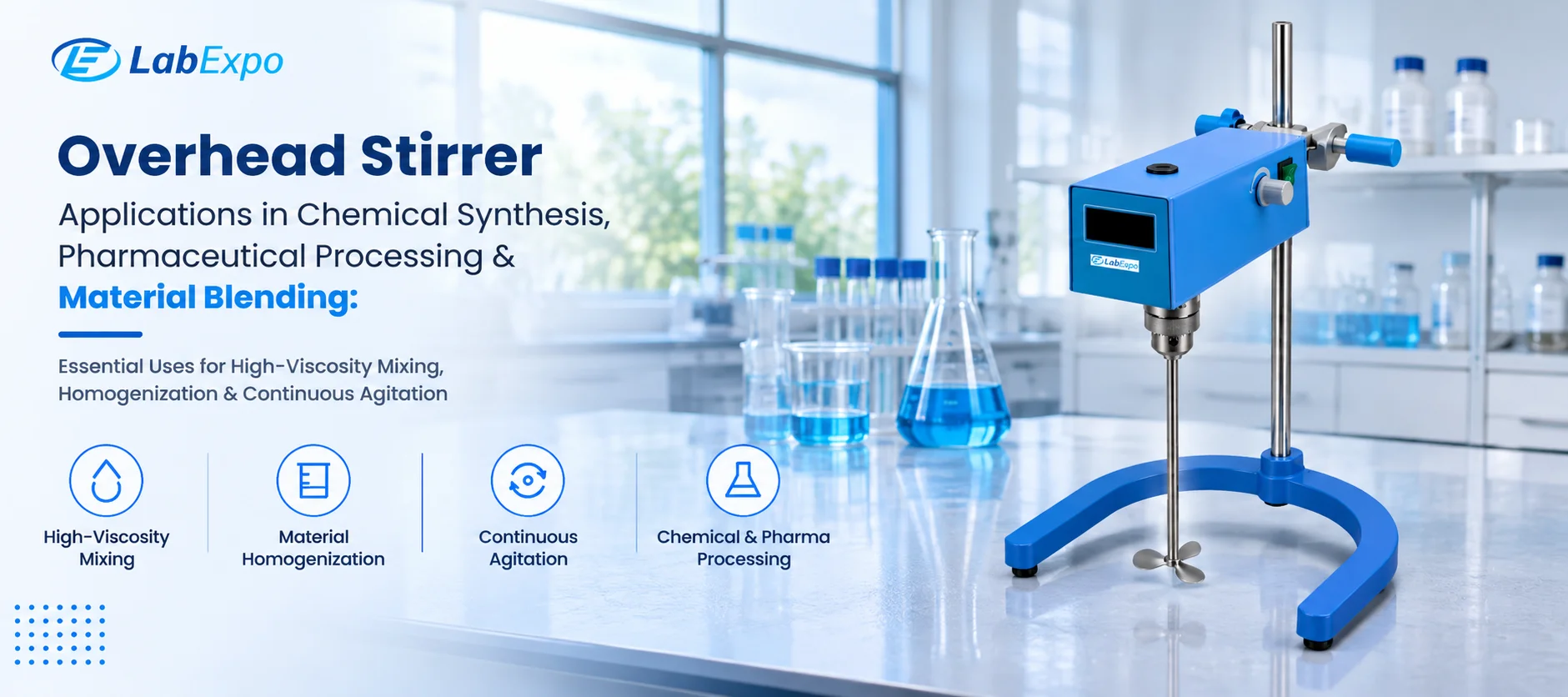
A magnetic stir bar stalls the moment a mixture turns thick, and a stalled mixture means uneven reactions and unusable batches. An overhead drive keeps turning where a bar cannot. This guide explains how it works, where it is used, how to set one up, how to read torque and speed figures, and which selection mistakes to avoid.
Why the Mixing Method Matters
Mixing quality decides how evenly heat, reagents and particles are spread through a batch. In a thick paste or a tall vessel, a stir bar decouples from its magnet and stops. An overhead mixer avoids that limit because the motor sits outside the vessel and drives the shaft directly.
The Overhead Stirrer LE-OS102 listing describes a brushless DC motor, a 60 to 1,500 rpm speed range, a stirring volume of 150 L of water and an LED display for speed.
How the Drive, Shaft and Impeller Work Together
An overhead stirrer machine has a few simple parts, and each one affects the result. The sequence below follows a typical run.
- 1
Clamp the head
The motor head is fixed to a stand above the vessel. The listing gives a holder length of 700 mm.
- 2
Grip the shaft
The chuck holds the stir rod. The listed clamping range is 1.5 to 13, with no unit shown on the page.
- 3
Fit the impeller
The blade shape decides whether the liquid is pushed down, sideways or scraped off the wall.
- 4
Set speed
The speed control sets rotation between 60 and 1,500 rpm, and the display shows the value.
- 5
Hold under load
A brushless DC motor adjusts to keep speed steady as the mixture thickens. The listing says it maintains speed under varying load.
- 6
Stop and clean
The motor is stopped before the shaft is raised, then the rod and blade are cleaned.
An electric overhead stirrer converts motor power into shaft torque, and torque is what moves thick material. A digital overhead stirrer adds a display so speed can be recorded and repeated between batches, which matters when a method specifies rpm. In plain terms the overhead stirrer mixer is simply the motor, shaft and blade working as one unit.
Practical Uses in Synthesis, Processing and Blending
Common overhead stirrer uses fall into four groups. The category page names laboratories, food production, cosmetics and the chemical industry as fields of use.
Chemical synthesis
Reactions in larger flasks need steady agitation for even temperature and reagent spread, especially when a product thickens or precipitates.
Pharmaceutical processing
Suspensions, emulsions and gels are prepared in development batches, where repeatable speed supports consistent samples.
Material blending
Polymers, coatings, pastes and cosmetic bases are blended until additives are spread evenly.
Continuous agitation
Long runs, such as dissolving slow powders or holding a mixture in suspension, depend on a motor that can run for hours.
Hospital and research laboratories use the same equipment for preparing reagents, buffers and test media in volumes too large for a stir bar. A laboratory stirrer of this type is a general tool, so the vessel, blade and speed still need to match each task.
Overhead, Magnetic and High-Shear Mixing Compared
No single mixer suits all samples. The table sets out typical differences, which should be checked against each method.
| Mixer | Works well for | Typical limit |
|---|---|---|
| Overhead stirrer | Large volumes, thick liquids, tall or wide vessels | Gentle to moderate mixing, not intense particle breakdown |
| Magnetic stirrer | Small, thin liquids in closed or sealed vessels | Bar decouples in thick material and stalls |
| High-shear homogenizer | Emulsions and particle size reduction | Generates heat and is less suited to long gentle agitation |
Many labs keep more than one type and choose by volume and viscosity. The wider overhead stirrer category shows how these units are grouped and which models are listed.
Choosing the Impeller for the Material
The motor supplies torque, and the blade decides how that torque turns into flow. The pairings below are general guidance, and blade fit should be confirmed against the chuck range and shaft length of the stirrer being used.
| Blade type | Flow pattern | Suited to |
|---|---|---|
| Propeller | Axial, pushing liquid along the shaft | Low to medium viscosity liquids and suspensions |
| Pitched blade | Mixed axial and radial flow | General blending and keeping solids lifted |
| Paddle | Radial, gentle | Slow mixing of moderately thick liquids |
| Anchor | Sweeps the vessel wall | Thick pastes and heat transfer at the wall |
The listing gives a standard stir rod of 350 mm in SS 304. Shaft length, vessel depth and blade diameter should be chosen together, so the blade sits low enough to circulate the whole batch without touching the wall.
Setting Up and Operating the Stirrer Safely
People searching for how to use overhead stirrer controls usually want a short procedure. An overhead stirrer for lab work follows the same logic on any bench, and the manual for the specific unit takes priority.
- Clamp the vessel firmly to the stand first, then align the shaft so it runs straight and clear of the wall.
- Insert the rod into the chuck to a safe depth and tighten it before powering on.
- Lower the blade to the planned height, usually about one blade diameter above the base.
- Start at the lowest speed and raise it gradually, watching for vortex, splashing or shaft wobble.
- Record the rpm and run time with the batch notes, so the method can be repeated.
- Stop the motor before raising the shaft, and rinse the rod and blade promptly.
Any overhead stirrer laboratory procedure should also include a splash shield or fume hood when volatile or hazardous liquids are used. Brushless motors avoid carbon-brush sparking, but flammable solvents still call for equipment rated for the area. The product page does not describe overload protection or other safety functions in its specifications, so that should be confirmed with the supplier.
Reading Torque and Speed Figures: A Worked Example
Shaft power equals torque multiplied by angular speed. The table below applies that formula to the listed 1 N·m torque, assuming it were available at each speed. It ignores losses and is illustrative only.
| Speed | Calculation | Shaft power at 1 N·m |
|---|---|---|
| 60 rpm | 1 × 2π × 60 ÷ 60 | about 6 W |
| 300 rpm | 1 × 2π × 300 ÷ 60 | about 31 W |
| 600 rpm | 1 × 2π × 600 ÷ 60 | about 63 W |
| 1,000 rpm | 1 × 2π × 1,000 ÷ 60 | about 105 W |
| 1,500 rpm | 1 × 2π × 1,500 ÷ 60 | about 157 W, above the 150 W motor rating |
The last row shows why a torque figure needs context. At the top of the speed range, full torque would exceed the listed motor power, so torque there is probably lower. For thick material, the useful figure is torque at the working speed, and a low speed with high torque is often what a paste needs.
The same caution applies to volume. The 150 L figure is for water, which is easy to move. Thick liquids need far more torque per liter, so the usable batch size for a viscous product is smaller, and the maximum viscosity is not stated on the page.
Specifications Worth Reading Closely
The values below come from the LE-OS102 listing. The second table shows details the page leaves unclear and that a buyer may need.
| Parameter | LE-OS102 listing | Why it matters |
|---|---|---|
| Speed range | 60 to 1,500 rpm | Covers slow paste mixing to faster liquid blending |
| Stirring volume | 150 L of water | A water-based figure, not a viscous-batch figure |
| Motor | Brushless DC, 150 W | Sets continuous power and sparking behavior |
| Torque | 1 N·m | Governs the ability to move thick material |
| Display | LED digital display | Supports repeatable speed settings |
| Stir rod | 350 mm, SS 304 | Sets vessel depth and chemical compatibility |
| Holder length | 700 mm | Affects clearance above tall vessels |
| Chuck clamping range | 1.5 to 13 (no unit shown) | Limits which rods can be fitted |
| Weight | 12 kg gross | Affects stand choice and handling |
| Supply | 220 V, 110 V optional | Needs a matching outlet or converter |
| Not clearly stated | Why a method needs it |
|---|---|
| Maximum viscosity | Decides whether a given paste can be mixed |
| Timer or run-time control | Supports unattended and timed steps |
| Overload and overheating protection | Protects the motor and the batch |
| Compatible blade types and sizes | Defines which tasks the unit can cover |
| Dimensions with a clear unit | Needed for bench and cabinet planning |
Selection Mistakes to Avoid
- Treating any overhead stirrer for laboratory use as interchangeable. Volume, viscosity and vessel shape differ between tasks.
- Choosing by volume alone. A water-based rating says little about a thick batch.
- Ignoring torque at the working speed. Peak torque and top speed rarely occur together.
- Mismatching the blade and vessel. A blade that is too small leaves dead zones, and one that is too large splashes.
- Skipping the clamp and stand check. A tall shaft on a light stand can wobble or tip.
- Overlooking material compatibility. Rods and blades should suit the chemicals in the batch.
- Forgetting the supply. A 220 V unit needs a matching outlet or the optional 110 V version.
- Comparing overhead stirrer manufacturers on headline figures only. Manuals, spare parts and service support matter over years of use.
Exploring the Wider Stirrer Range
This unit belongs to the laboratory stirrer family at Lab Expo, which groups overhead units alongside other stirring equipment under the laboratory stirrer category. The full overhead stirrer range lists all the models currently shown.
Each model has its own product page. Buyers usually compare speed range, torque and motor power, stirring volume and viscosity limit, chuck size and rod length, timer and safety functions, and supply voltage options.